Singapore: Cibulkova Interview
An interview with Dominika Cibulkova after her semifinal win at the BNP Paribas WTA Finals Singapore presented by SC Global.


An interview with Dominika Cibulkova after her semifinal win at the BNP Paribas WTA Finals Singapore presented by SC Global.
New WTA Finals champion Dominika Cibulkova is about to step up into the Top 5 rankings – and for the first time in her career, she genuinely feels she belongs there.
The Huajin Securities WTA Elite Trophy Zhuhai gets underway on Tuesday, Elina Svitolina and Timea Bacsinzsky among those hoping to make a winning start to their final event of 2016.
ZHUHAI, China – No.12 seed and wildcard Zhang Shuai rang in the start of the Huajin Securities WTA Elite Trophy Zhuhai in impressive style, defeating No.6 seed Timea Bacsinszky, 6-1, 6-1, to take the early lead in the Camellia Group.
“I am very happy to win, actually just to play in my home country and win the first game here,” she said after the match through translation. “I cannot say how happy I am about this.
“It’s been three weeks since the China Open, and during that time it was a bit tough for me. Without game I kind of don’t know what to do with my life! Even though continuous game and competition makes me tired. I like playing even more.”
Zhang is in the midst of a career-best season, one that has seen her rise from outside the Top 100 to a high of No.27 after reaching the quarterfinals of the Australian Open and China Open just three weeks ago. Playing Bacsinszky, a former Top 10 player whom she narrowly beat at the Olympic tennis event, Zhang blistered past her Swiss opposition in 57 minutes, dropping just three points behind her first serve.
.@zhangshuai121 delivering her post-win press conference @WTAEliteTrophy pic.twitter.com/CYedNrwyrE
— WTA Insider (@WTA_insider) November 1, 2016
“It’s been three months since the Olympics by now, and I did see my progress in the performance. I have to say this is not a coincidence. I am pretty confident in myself now.
“I just watched some of the video parts of me playing Bacsinszky during the Olympics and I can see that after that and after all the games in Beijing and Japan and Wuhan and Korea I really improved a lot. I believe that if I can make the best out of my training I can play even better game. I also do enjoy my home court advantage here. It was great game for me.”
Hoping to reach the semifinals in her Zhuhai debut, Zhang will have to get past first alternate Timea Babos, who entered the Camellia Group after No.2 seed Carla Suárez Navarro withdrew due to a right wrist injury.
“I am physically doing very well. After Beijing I took three weeks off and I well adjusted myself. I’m fully recovered now.
“I can say that I’m at my best at this moment. “That is one of the reasons why I played well.”
In the second match of the day, Elina Svitolina overcame a slow start to defeat Kiki Bertena, 2-6, 6-4, 6-2.
“I think she started playing really well and I was bit in and out with my attitude and with my game,” Svitolina said after the match.
“But then I was just waiting for my chances, and I think in the second set I took my chances. In the end I think just playing solid was the key for me today.”
.@CarlaSuarezNava has withdrawn from @WTAEliteTrophy due to the right wrist injury sustained in Moscow. Babos next in. Statement from CSN: pic.twitter.com/btQA3S4tgI
— WTA Insider (@WTA_insider) November 1, 2016
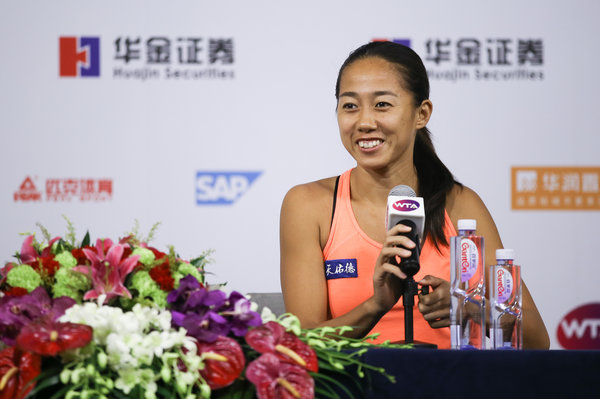
ZHUHAI, China – The fairytale continues for Zhang Shuai in Zhuhai.
The wildcard won a second straight match at the Huajin Securities WTA Elite Trophy Zhuhai, guaranteeing her a place in the semifinals and a first career finish inside the Top 25.
“It’s amazing because I never thought I could play this tournament, and now I’m in the semifinals,” she told WTA Insider on Thursday. “I prepared a lot for this week, so I’m really happy.”
Her storybook season began in Australia by way of Tokyo. Zhang was ranked just inside the Top 200 when she won an inaugural ITF 100K Challenger there last fall – foreshadowing what was to come Down Under. The Chinese No.1 plans to return to the Tokyo tournament next week, where she will be top seed.
“I have a lot of good memories there and want to go back. I also have a lot of friends in Japan and Tokyo; they’re waiting for me already, so it’s very exciting!
“The tournament has good food, good hotel, and good courts. I always look forward to going to Tokyo.”

Zhang’s season won’t end there. Her final stop of 2016 brings her to Hawaii, fulfilling a lifelong dream.
“I’ve never had the chance to go. I’m already ranked in the Top 50, so I couldn’t enter a WTA 125K event, so I have to thank the tournament for giving me a wildcard.”
She found out about the wildcard into Zhuhai three weeks ago in Beijing; she had just defeated Simona Halep for the second time in nine months, the first coming in that fateful first round in Melbourne.
“She’s a really great player. My coach always says I have to learn from her, because she plays really beautiful tennis. I like her as a person too; she’s a very nice girl.
“It was amazing, even after the Australian Open, I didn’t think I could beat her again. But I’ve since been able to not only beat her, but also other Top 20 players like Timea Bacsinszky and Samantha Stosur.
“Now I believe I can do anything.”
That limitless mentality has helped her achieve a career-best season after a year in the tennis wilderness. It was just two years ago that Zhang was ranked in the Top 30 and seeded at Grand Slams, but until beating Halep, she had never won a major main draw match in 14 previous attempts.

“Now I’m more focused on the court, focused on myself. I don’t think…anything, really! I’m not thinking about ranking or points; I just try my best, trying to play my tennis and my style. I don’t really care about whom I’m playing, or how they play. I just go!”
Zhang plans to roll into the off-season with similar gusto, hoping to maintain the momentum gained from her Asian Swing surge and bring it back to Australia for an encore performance.
“I don’t think I’ll change much about my pre-season. I’ll just try to train hard, give 100% of my heart and focus on tennis. We’re always trying to make improvements, so we’ll try to do that, too.
“But this year, I played really well, so I think I’m doing things the right way. I just want to keep going.”
Forward motion is a recurring motif from Zhang, which certainly makes sense; if you were living her dream, would you want to wake up?
“This whole year has been filled with so many amazing memories. I can’t pick just one, but of course, I can’t forget the Australian Open. I’ll remember that week forever. I also made the quarterfinal at the China Open, now the semifinals here in Zhuhai.
“This year has been a dream come true.”
All photos courtesy of WTA Elite Trophy.
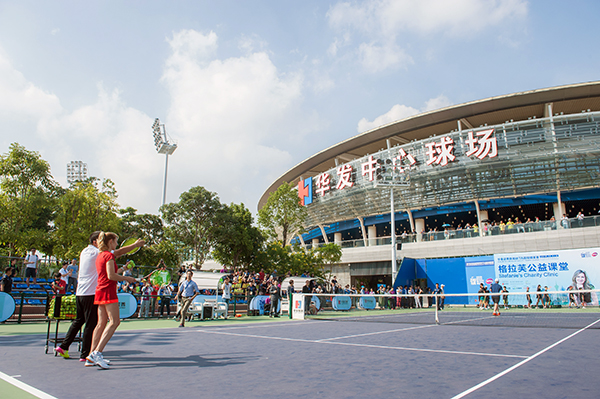
ZHUHAI, China – After visiting one of the city’s most impressive landmarks, tennis legend and WTA Elite Trophy ambassador Steffi Graf continued her whirlwind tour of Zhuhai at the Huafa Tennis Center for a charity clinic.
Click here for a photo gallery of all of Steffi’s activities in Zhuhai!
Graf was joined by over thirty talented youngsters from primary and junior high schools in the area, including 19 from Macao as well as from Huajin Securities, tournament ball kids, selected staff and one lucky iQYI SuperFan.
Yang Yanling, who was selected from the iQIYI iSuperFan campaign, got an extra treat; he enjoyed a special one-on-one conversation up close with the former World No.1. Yang was thrilled by Graf’s encouragement to continue playing tennis, and more importantly, to enjoy what tennis will bring to his life and future.
Check out all the best photos from the event right here, courtesy of the WTA Elite Trophy!


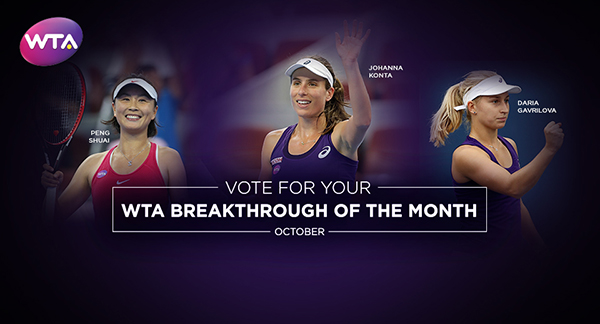

October was defined by three breakthrough players who brought some impressive performances on and off the court. Which one soared the highest?
Have a look at the nominees for October Breakthrough Performance of the Month and cast your vote before Thursday at 11:59pm ET! The winner will be announced Friday, November 11.
October 2016 WTA Breakthrough Performance of the Month Finalists:
Daria Gavrilova: One of the tour’s fastest rising stars had an October to remember. The Russian-born Aussie kicked off the month with her first win over a reigning No.1, defeating Angelique Kerber in Hong Kong. Gavrilova took that momentum into Moscow to reach the final of the Kremlin Cup in both singles and doubles with partner and good friend Daria Kasatkina.
Johanna Konta: Konta made her biggest breakthrough yet on the WTA level, reaching her first Premier Mandatory final at the China Open. Seeded No.11 in Bejing, Konta upset No.5 seed and US Open runner-up Karolina Pliskova and No.8 seed Madison Keys en route to the championship match, where she fell to Agnieszka Radwanska.
Peng Shuai: Impressive though her resume had been, a WTA singles title had long eluded 2014 US Open semifinalist Peng Shuai, who missed most of the 2015 season due to a back injury. Upsetting Venus Williams in Beijing, Peng rolled into the Tianjin Open high on confidence, finally winning her first WTA title.
2016 Winners:
January: Zhang Shuai
February: Jelena Ostapenko
March: Nicole Gibbs
April: Cagla Buyukakcay
May: Kiki Bertens
June: Elena Vesnina
July: Kristina Kucova
August: Karolina Pliskova
September: Naomi Osaka
How it works:
Finalists are selected by wtatennis.com
Winner is then determined by a fan vote on wtatennis.com
The third edition of the BNP Paribas WTA Finals Singapore presented by SC Global featured first-time champions in singles and doubles, a new year-end singles World No.1 in Angelique Kerber and the crowning of Sania Mirza as the top doubles player of the year. The 2016 Finals also set records off the court thanks to an unprecedented increase in social media engagement.
Dominika Cibulkova’s unexpected run to the final on her tournament debut was experienced by more fans than ever. Compared to the 2015 tournament, Facebook video views were up 571%, engagement on WTA-operated social media platforms increased by 247% and wtatennis.com referrals from social media improved by 167%.
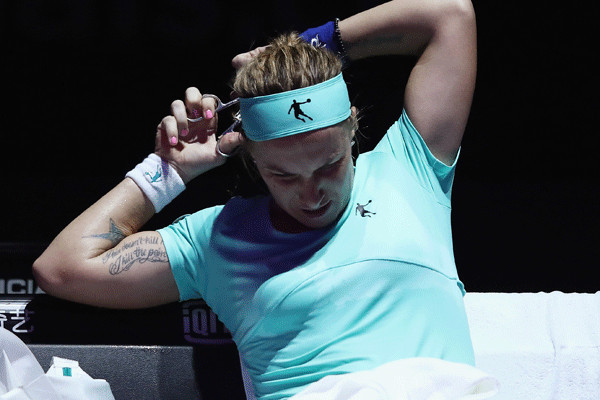
The upsurge in engagement was driven by a ‘social first’ content strategy featuring on and off-court action, humorous player videos, match reporting, opinion editorials, innovative design and behind the scenes video on Facebook Live, Instagram Stories and Snapchat. The best-performing content pieces included the moment Cibulkova won title, a Facebook Live fan Q&A with Indian superstar Mirza, Svetlana Kuznetsova’s on-court haircut and live coverage of the iconic photoshoot, draw and gala dinner.

The increase in exposure was not just limited to web platforms with the 2016 Finals yielding a 4% increase in global TV household reach compared to 2015, thanks to increased exposure in Russia, Germany and Austria.
In addition to Cibulkova’s upset victory over Kerber, Olympic gold medalists Ekaterina Makarova and Elena Vesnina broke Bethanie Mattek-Sands and Lucie Safarova’s 18-match winning streak to lift the Martina Navratilova WTA Finals Doubles Trophy. Mirza finished as year-end World No.1 doubles player for a second consecutive season. Mirza has held the No.1 ranking for 83 consecutive weeks.
Melissa Pine, Vice-President of WTA Asia-Pacific and Tournament Director of the WTA Finals, said, “The Road to Singapore this year has been yet another exciting race to the finish line and the tennis action at the WTA Finals has truly reflected the top quality level of play among the greatest eight of 2016. We are thrilled with how the fans in Singapore and around the world have warmly embraced the event as well as shown their enthusiasm for women’s tennis.”
Was it WTA Finals champion Dominika Cibulkova, the resurgent Petra Kvitova or on-the-rise Johanna Konta? They came close, but one player amassed the most WTA match wins in 2016.
Top seeds Alizé Cornet and Caroline Garcia battled past a pair of tricky opponents to reach the quarterfinals at the Engie Open Limoges, staying on track for a finals day clash.