LONDON, Great Britain – Bits and bobbles from the Day 1 at Wimbledon, which went off without a hitch. Almost.
Ana Ivanovic stunned by Russian qualifier: The No.23 seed lost to No. 223 Russian qualifier Ekaterina Alexandrova 6-2, 7-5 in 70 minutes. Ivanovic told reporters after the match that she contemplated skipping Wimbledon due to wrist inflammation that got worse at the Mallorca Open.
“During the Mallorca tournament, it really got inflamed,” Ivanovic said. “Then I had couple of days off. It start to calm down a little bit. Every time I would start hitting, it would flare up. I felt like I could probably manage it. It’s tough on grass because ball really skids through. She was hitting very, very heavy. So, yeah, it was disappointing.
“For two weeks I struggled with my right wrist. It was very hard to accelerate on my forehand. I tried to do everything possible to be fit and recover and tape it and so on.”
Ivanovic will get an MRI on the wrist and does not plan to play a tournament until the Olympics.
Stosur and Lisicki set to clash: The two came through easily in their first round matches and will face off in the second round. Stosur leads the head-to-head 5-2 but she’s obviously wary of Lisicki’s ability to summon some magic at Wimbledon.
“I don’t know what she did actually in the grass court tournaments before this one, but she probably hasn’t had a fantastic year so far, but I’m sure when she walks through the gates here she probably feels like she’s No.1 in the world,” Stosur told reporters.
“You have to be aware of that and know she has a very big serve. She plays big and hits the ball hard. She absolutely plays aggressive. If she’s on that day, you have got to be really willing to fight fire with fire and go after it, and, yeah, not kind of feel like you’re going to get dictated to.
“Against someone like her with a game like she’s got, it’s very easy to feel under the pump and under pressure all the time if she’s playing well. You have to be aware of that and balance out the patience and consistency with your own aggression.”
Serena and Venus in 2020: The sisters have been peppered with questions about their doubles preparation for the Olympics. “We have to start looking at 2020,” Venus said with a laugh. “That would be impressive. If you think this year’s impressive, hold on. That would be a blessing if we did play.”
I’m not going to question it. Would you?

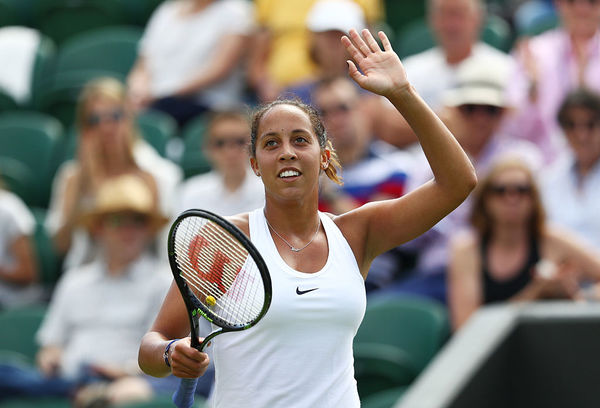
Madison matures: Madison Keys is in the midst of her most consistently high-level span of play in her career. She’s been solid since Fed Cup in April, and she rolled through her first round match against Laura Siegemund, winning 6-3, 6-1. There’s a sense of calm about her these days.
“I think in a lot of ways I have changed,” she said. “But I also think every 18 year old changes a lot from 18 to 21 to 25. So I think on and off the court, I have changed in a lot of ways. And I think just a big thing is experience wise, it’s still only my third full year, fourth full year on tour. Obviously there is plenty of experience that I can still have.
“But just feeling more comfortable and knowing what to expect and it becoming more of a routine has really helped me. I think the maturity level of being able to handle a lot of what’s thrown at me has been a big difference.”
Garbiñe Muguruza battles to get past Camila Giorgi: Absolutely no one wants to draw the dangerous Italian in the first round of any tournament, let along on the fast grass at Wimbledon. But the No.2 seed came through in three sets by, once again, not panicking. It was a confident win for Muguruza, who came in with just one grass match under her belt, a loss to Kirsten Flipkens in Mallorca.
“Sometimes you don’t win the most beautiful way,” she said. “You got to be there fighting and waiting for your chance, especially against a player that bangs the ball. Is a very tough opponent to begin the tournament.” She plays Jana Cepelova in the second round.

Third time’s a charm for Daria Kasatkina: Seeded in her Wimbledon debut, the 18-year-old earned her first win ever on grass with a 6-0, 6-4 win over Victoria Duval. “My third match on grass in all my life,” Kasatkina told WTA Insider. “The first was at Wimbledon 2012. It was so bad. Now I’m professional, I come on grass, I can say I like it.”
Primarily known as a clay-courter, Kasatkina said with a few minor adjustments she’s feeling comfortable on grass. “The first few practices were really, really terrible. Better not to see this,” she said laughing.
“Because I was trying to change my game because I thought it was totally different tennis. But my coach told me no, you don’t have to change so much. Just little bit adapt for grass tennis. Just go for the volley or something like this. And it’s a little bit more difficult to move. It’s a little bit slippery and you have to move like a cat. Soft steps. But we worked a lot in fitness for this, so I adapt to that.”
Kasatkina admits she was tired through much of the clay court swing but feels refreshed on the grass. “In Madrid I was finished because it was so complicated calendar,” she said. “America, Fed Cup, then immediately I go to clay court preparation. It was too much for me. After Roland Garros I had a few days off and I came to the grass more fresh.”
As for qualifying for the Russian Olympic Team, the young Russian is over the moon. “If last year somebody told me I would go to the Olympics I would tell him you are a crazy man.”

Maria Sakkari on the verge of the Top 100: Sakkari scored a good win over Zheng Saisai, winning 6-3, 6-2 for her first win at Wimbledon. In fact, the first time she ever played on grass was last week in qualies at Roehampton. “I never practiced on grass, I never played juniors on grass,” she told WTA Insider. “I just practiced twice before my first match. It’s fine. I like it. It’s different. But if you take care of your steps and your running and think about it more in the beginning then it’s fine.”
Asked whether her mother, who played on tour, gave her any advice about the grass, Sakkari said she kept it simple. “My mom never liked grass,” she said. “She played once or twice at Wimbledon. She told me not to try too many things. Don’t try to hit too hard. Just play tennis.”
Crawford earns her first Slam win: After a blistering start to the season, making the semifinals of the Brisbane International as a qualifier, Samantha Crawford finally earned her first main draw win at a Slam, beating Paula Kania, 7-5, 6-3 at Wimbledon. The win was especially sweet given Crawford had played just one match since breaking her hand in a fall at the Volvo Car Open in April. Crawford fractured the scaphoid bone in her right hand and was in a cast for six weeks, but was able to come back at the French Open last month.
“Before it happens it’s in the back of everyone’s mind,” Crawford said, when asked about getting her first Slam win. This was just her third match on grass ever. “This is my fifth Slam main draw. I was aware that I hadn’t won. I got a little nervous but I told myself to enjoy the moment being at Wimbledon.”

Questions that need to stop: I think it’s time to put a moratorium on asking players why they don’t have a pep in their step during press conferences.
Q. You seem quite down.
LAURA ROBSON: I seem quite down? Probably because I lost. It tends to do it.
Robson lost 6-2, 6-2 to Angelique Kerber, but will still be around Wimbledon for doubles with Ashleigh Barty. She will head to the US afterwards to play on the ITF Circuit to get her ranking up.
“For me, it’s a massive win to be here and not have any niggles for quite a few months now, apart from a very small one in Eastbourne,” she said. “I’ve worked very, very hard to be healthy, to be completely fit on court. It’s 100% a huge goal for me to finish the year in the same way. Yeah, it’s now about winning matches, as well.”
To Infinity, and Beyond: How’s this from Venus Williams:
Q. Looking back to 26, would you have thought that you would still be engaged at 36?
VENUS WILLIAMS: I still feel 26, so… You know, I don’t think anyone feels older. You have this infinity inside of you that feels like you could go forever. That’s how I feel on the court. As long as I’m halfway decent, can get my racquet on the ball, I think I can make something happen. So far so good.
All photos courtesy of Getty Images.