The Qatar Total Open draw is out and next week’s Premier 5 tournament sees the return of Australian Open champion Angelique Kerber, defending champion Lucie Safarova, and one of the hottest players of the last five months, Agnieszka Radwanska.
Kerber gets back to work: Since her maiden win at the Australian Open, Kerber has been back in Germany, where she played two Fed Cup singles matches in Leipzig and then hit the local media circuit — nice shot, Angie — before pulling out of last week’s Dubai Duty Free Tennis Championships due to a right thigh injury.
Now the World No.2 returns to the tour as the top seed in Doha, a tournament that has been a mixed bag through her career. As the only player this year to make two finals, Doha offers a solid test for Kerber’s consistency. She reached the final in 2014 – falling to Simona Halep – but has won just one match in five other appearances.
Kerber has a bye in the first round and will open against either Varvara Lepchenko or Zheng Saisai. Petra Kvitova, Garbiñe Muguruza, and Belinda Bencic are the top eight seeds in her half of the draw.
Lucie Safarova returns from illness: After an incredible season that saw her win the biggest title of her career here in Doha last year – and go on to make her first major final at the French Open – Safarova’s season ended with a whimper. Diagnosed with a bacterial infection that left her hospitalized after the US Open, Safarova skipped Australia to continue healing. Doha will be her first tournament of the season.
Safarova will drop out of the Top 10 on Monday but she’s seeded No.7 in Doha. Drawn into the bottom half opposite No.2 seed Simona Halep, she has a first round bye and will play either Lucie Hradecka or Cagla Buyakakay. That’s as nice an opener as she could hope for in this loaded draw.
Radwanska hopes to pick up where she left off: Up to No.3 on Monday, Radwanska took some time off after the Australian Open, where she did well to make the semifinals before losing to Serena Williams. That 6-0, 6-4 loss was a tough one to take, but it doesn’t change the fact that no one has been on a hotter streak over the last six months than Radwanska. Since the US Open she’s won four titles – including the BNP Paribas WTA Finals Singapore presented by SC Global – and has just one loss so far this season.
Last week’s withdrawal from Dubai due to a lower leg injury was surprising, but it’s also encouraging to see Radwanska manage her schedule to protect her body. After an opening round bye she’ll face either Annika Beck or a qualifier.

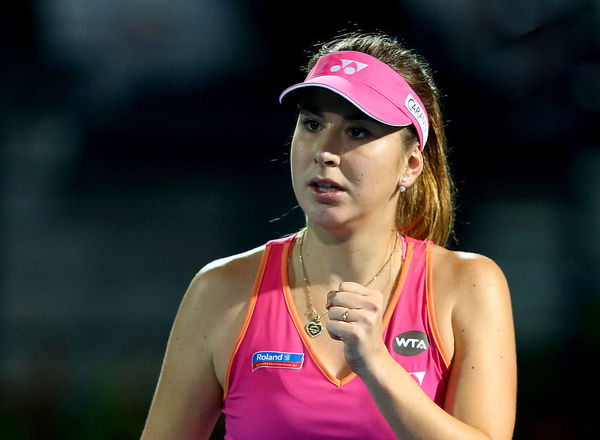
Bencic puts her consistency on the line: Given how many events she’s played in 2016, there’s a fair argument to be made that Belinda Bencic has been the most consistent player on tour this year. Set aside a surprise second round loss to Samantha Crawford at the Brisbane International and a loss last week to Jelena Jankovic following a brutal turnaround from St. Petersburg, and Bencic has been the WTA’s most reliable performer.
Bencic has already played six events this season (including Fed Cup) and goes into Doha with 12 wins already under her belt, just one short of Kerber’s tour-leading 13 wins. Her run to the St. Petersburg final propelled her into the Top 10 for the first time and she’s a clear title contender this week. She’ll open against CoCo Vandeweghe or a qualifier in the second round.
Looking for a kickstart: After the 0 for 8 run of the seeds last week in Dubai, quite a number of players turn to Dubai still searching for a kickstart to their seasons. No.2 seed Halep, No.4 seed Muguruza, and No.5 seed Kvitova. All three have played three tour events each this year and have won five matches between them (Halep – 2, Muguruza – 2, Kvitova – 1).
Kvitova has the toughest opening draw. She plays either Kristina Mladenovic or Dubai finalist Barbora Strycova. Halep plays either Dubai semifinalist Caroline Garcia or a qualifier. Muguruza opens against either Nao Hibino or Yaroslava Shvedova.
From a rankings perspective, Halep in particular is under fire. She failed to defend her title last week in Doha and will need to defend Indian Wells and a semifinal in Miami when the tour turns to the North American hard courts next month. A good run in Doha would pick up some much needed points while also giving her a boost of confidence for her upcoming events.

Eugenie Bouchard takes a wildcard: The Canadian, currently ranked No.61, had an encouraging start to the season. She made the Shenzhen Open quarterfinals and her first final in over a year at the Hobart International. A tough draw saw her bow out early at the Australian Open, with a straight set loss to Radwanska in the second round.
She pulled out of the Rio Open last week citing a change of schedule – she played the NBA Celebrity All-Star game last Friday – took a wildcard into Doha, where she will make her main draw debut. She is entered in Kuala Lumpur next week. She opens against a qualifier and could play Elina Svitolina in the second round and Kerber in the third round.
Projected quarterfinals: Kerber vs. Kvitova, Muguruza vs. Bencic, Radwanska vs. Safarova, Halep vs. Suárez Navarro.
First round matches to watch: Svetlana Kuznetsova vs. Julia Goerges (a rematch of last week’s rout in Dubai), Karolina Pliskova vs. Margarita Gasparyan, Andrea Petkovic vs. Ekaterina Makarova, and Timea Bacsinszky vs. Bethanie Mattek-Sands.
All photos courtesy of Getty Images.