Miami: Johanna Konta vs Caroline Wozniacki
Johanna Konta takes on Caroline Wozniacki in the final of the Miami Open.


Johanna Konta takes on Caroline Wozniacki in the final of the Miami Open.
Five Top 20 players are in action this week in two WTA events that are being staged for the first time.
Here’s 10 Things To Know about St. Petersburg and Kaohsiung!
1) St. Petersburg has four Top 20 players in the draw.
No.11 Belinda Bencic, No.16 Roberta Vinci, No.18 Caroline Wozniacki and No.20 Ana Ivanovic are all in action this week at the St. Petersburg Ladies Trophy.
2) This is the first edition of St. Petersburg Ladies Trophy as a WTA Premier event.
The event was previously held six times as an ITF tournament (from 2003-2008 and in 2015) and this year marks the first time in 25 years that WTA tennis returns to St Petersburg, Russia.
3) Bencic leads the pack in Russia…
For the first time in her career, Belinda Bencic is the No.1 seed at a WTA tournament at St. Petersburg. Her previous highest seeding was No.3 in Washington DC last year.
4) … While another 18-year-old is hoping to make big moves.
Daria Kasatkina is one to watch in St. Petersburg: She’s the second youngest player in the main draw and is coming off her joint-best result at a Grand Slam after reaching the 3rd round at the Australian Open, where she knocked out No.29 Anna Karolina Schmiedlova for the biggest win of her career.
5) Bencic and Wozniacki could face each other in the semifinals.
No.3 seed Caroline Wozniacki, who took a late wildcard into St. Petersburg, is on a semifinal collision course with Bencic, who beat her four times in 2015. See how the draw breaks down here.
6) A former World No.1 headlines in Kaohsiung.
And with 48 WTA titles to her name, No.1-seeded Venus Williams has more titles than the entire Taiwan main draw put together!
7) The Taiwan Open in Kaohsiung is the first WTA event in Taiwan.
Taiwan’s first taste of WTA tennis came back in 2012, with Taipei hosting a WTA 125K Series event from 2012 to 2015.
8) Elizaveta Kulichkova is one to watch.
Kulichkova enters the Taiwan Open following a string of career bests: at the Australian Open she reached the 3rd round of a Grand Slam for the first time and scored her career best win over No.25 Andrea Petkovic.
9) The Taiwan Open is one out of a record nine WTA Premier and International tournaments hosted on the Chinese Mainland, Hong Kong and Taiwan…
The other eight are the China Open in Beijing, Dongfeng Motor Wuhan Open, Guangzhou International Women’s Open, Prudential Hong Kong Tennis Open, Jiangxi Women’s Tennis Open in Nanchang, Shenzhen Open, Tianjin Open and WTA Elite Trophy Zhuhai.
10) Check out all the best live action this week on WTA Live powered by TennisTV.
And learn how you can follow it all right here.
MIAMI, FL, USA – The British media celebrated Johanna Konta’s win at the Miami Open with plenty of print space and air time – and are hoping she’ll rise even further up the rankings than her current career high of No.7.
Konta said in her post-match press conference that she hoped her journey in the tournament would garner lots of attention for the sport.
“If the coverage has been good then it’s great for us,” said the British No.1. “It’s promoting tennis, and hopefully promoting more people to play.”
And so it has proved – starting with a front-page splash in the Sunday Times.
No stunts required – win as big as Konta is starting to, it gets attention. Front page of the Sunday Times. pic.twitter.com/VQKgSUsnt9
— DavidLaw (@DavidLawTennis) April 2, 2017
Comparisons are inevitably being drawn with Virginia Wade, Britain’s last female singles Slam winner – but Konta has played that down, although she admitted she would love to win Wimbledon.
The Daily Mail reported that she said: “It does sound quite monumental but winning Wimbledon is a dream and hopefully one day I will get an opportunity to play for such a title.”
An unforgettable two weeks for @JoKonta91 at the @MiamiOpen! ? pic.twitter.com/XuN5Snv16F
— WTA (@WTA) April 2, 2017
The Daily Telegraph’s tennis correspondent Simon Briggs assessed Konta’s chances of a Slam title thus: “How much further, then, can this late-blooming champion climb? Two years ago, Konta was ranked around the 150-mark, which did not even earn her a spot in the qualifying tournament here. Now she stands alongside Pliskova and world No 1 Angelique Kerber as one of the women most likely to worry Serena Williams.”
In the Guardian, Kevin Mitchell wrote: “Konta was clearly the better player in this match as well as the one in Melbourne. That was such a clear indicator of how far the British No1 has come in a relatively short time. There would not have been many takers backing Konta to beat Wozniacki even a couple of years ago. Now she has to set her sights higher.”
And of course Konta’s Fed Cup teammates were also thrilled for her – Naomi Broady and Heather Watson were straight on Twitter to publicly congratulate their friend.
She came, she saw, she 'kontad' ? best tweet I've seen today! Killing it JK ? @JoKonta91
— Naomi Broady (@NaomiBroady) April 2, 2017
Congrats @JoKonta91 ! ?????? #killinit
— Heather Watson (@HeatherWatson92) April 1, 2017
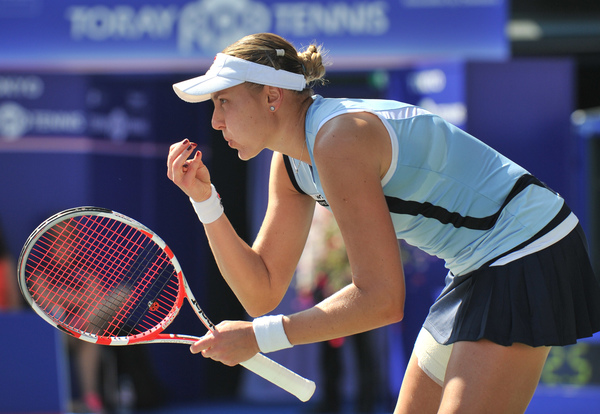
The St. Petersburg Ladies Trophy debuts on the WTA calendar following an Australian Open that featured impressive performances from a trio of talented young Russians. Among them, Margarita Gasparyan reached her first major second week, while former French Open junior champion Daria Kasatkina made a second straight Grand Slam third round. Each fell to World No.1 Serena Williams; each will be on hand to play her home tournament.
On the outside looking in is another Russian Roland Garros junior champ – off the court for the last two years with a torn labral, but one who knows a thing or two about playing the 21-time Grand Slam champion on Rod Laver Arena.
Former World No.3 Nadia Petrova played a pair of must-watch Melbourne matches against the American in the mid-00s – the last coming in 2007, when Williams was ranked No.81.
“I remember that match,” Petrova told WTA Insider last fall. “I was two points away from winning, serving for it. But in this critical situation, she came up with some amazing shots and I was pushed back to the wall. I tried everything and she would come up with something even better.”
The Muscovite later got her revenge in Beijing and Madrid, becoming one of the few players to earn back-to-back wins over the World No.1.

“I always enjoyed our matches; every time I stepped on the court against her, I was never intimidated. I knew what I had to do in order to win, or at least play a good match.”
A prominent part of Russia’s golden generation – one that includes Grand Slam champions Maria Sharapova, Svetlana Kuznetsova, and Anastasia Myskina, Olympic Gold medalist Elena Dementieva, and World No.1 Dinara Safina – Petrova has been trying to heal an injury she first picked up during the 2013 French Open – ten years after she became the first Russian woman since Olga Morozova in 1975 to reach the semifinals on the terre battue.
“It was very cold that year,” she said of her first round loss to Monica Puig. “I thought my muscles were just overworked. The doctors and physios said that I needed a good break and I would be fine for the grass court season.
“I followed that advice, but when I returned to court, it got worse, to the point that I struggled through my first round at Wimbledon. It was a little bit easier in doubles, but I had to do more medical research and see some other specialists.”
Despite managing to qualify for a sixth overall WTA Finals appearance with Katarina Srebotnik, the 37-time WTA titlist (13 singles, 24 doubles) soon made the decision to stop playing altogether in the hopes of fully healing her hip before launching a return.
“I’d rather be playing tournaments, going from one place to another. I miss all the emotions, the excitement of a win or a loss. That part of me is missing right now, but unfortunately my hip has been still giving me a hard time.”

No stranger to long lay-offs, a then-19-year-old Petrova was poised for a breakout 2002 season when a stress fracture stunted her progress for six months.
“That was a reality check, and a big test for me,” she said of her first major injury. “I’d had a great off-season, and I started really well in my first event, almost beating Venus Williams. I was a Top 30 player for the first time, but right before the Australian Open, I had to pull out because of my foot.
“It was hard seeing the Australian Open, French Open, Wimbledon just go by. All that was left was to just see it on TV. My ranking dropped out of Top 100, and it was the first time that I had to start from the scratch. But I managed, and I’m sure that made me a stronger and better player.”
Rehabbing a labral tear presently remains the biggest test for the now-33-year-old Russian, who refuses to make any immediate decisions about her future.
“I’ll feel like I’m making improvements, but as soon as I start loading my body with practicing and playing, it starts showing signs of breaking down again. I think it’s from the years that I’ve been on tour, the wear and tear.”

For a woman on the move for most of her life, 24 months at a standstill has been a “mixture of emotions” for the two-time Grand Slam semifinalist, who has spent the time finishing the renovations on her Miami home, giving back through her eponymous foundation, and otherwise enjoying a normal life with her dog.
“It does feel good to be in one place. It’s nice to wake up in your own bed every morning, but after doing it for so many years, you get used to the traveling. Sometimes I do miss getting on a plane and going somewhere, the change of surroundings. I’m getting a bit tired of being in one place.”
The daughter of elite athletes – her mother was an Olympic bronze medalist in the 4×400 meter relay – Petrova began playing tennis at eight years old; she left Moscow at 12 as her parents pursued coaching opportunities in Egypt and Poland.
As a teenager, she relocated to the Netherlands to work with coach Glen Schaap (who later worked with Safina and junior rival Jelena Dokic), but admitted it was hard to ever feel at home in any one place.
“I really didn’t get attached to people. Of course, you make friends, but it’s not like ones you grow up and go to school with, and you create a strong bond. It’s hard to leave those kinds of people behind, but I didn’t really have that.
“I do have a lot of friends in all these places that I still keep in touch with, and I did enjoy traveling. I was a teenager that really liked exploring new places, getting to know new cultures, cuisines. For me, it was fascinating.”

Some of her strongest bonds were forged during her brief tenure on the junior circuit, where she upset Dokic for the 1998 junior title in Paris.
“We were competing against each other but we still were into socializing and hanging out. We would always do something fun after the tennis was over. It was a lot of good quality time.
“Transitioning from juniors to pros, we kept close, tried to support each other, show up at each other’s matches. But it was an emotional rollercoaster because there’s a big gap in level. Everyone is older, more experienced, and a lot stronger.
“It was a difficult moment and, of course, when you are a brand new player on the tour, it’s not like everyone is warm and welcoming. You have to earn your spot among the players, and prove yourself with good wins.”
Former No.1 Tracy Austin once remarked, “Every time Petrova gets up a head of steam, she gets injured.” Indeed, physical issues of varying severity likely kept the Russian, with her big serve and booming all-court game, from realizing her potential in an era that boasted both Williams sisters, Belgians Justine Henin and Kim Clijsters, Americans Lindsay Davenport and Jennifer Capriati, Swiss Miss Martina Hingis, French star Amélie Mauresmo – and, of course, all of her countrywomen.

“It’s just genetically how my body is built and how it handles all the sudden movements in a match. A lot of leg injuries and muscle strains I had came from my lower back and my pelvis being out of alignment. It took me a while to understand that, to start taking proper care of my body.
“I’m also not that kind of a player where, if I’m out for two-three months, I can pick up where I left off. It would take me a while to get back into everything – the tournaments and months of practice – to that same level where I could feel and see the game, to feel confident on the court again.”
When it came together, she was almost unstoppable. She won her own Olympic Bronze medal in women’s doubles with Maria Kirilenko and titles on all surfaces in her 15 years on tour. She defeated 16 of her generation’s 18 Grand Slam champions, and 13 of the 14 women who had been or went on to be World No.1.
She is one of only ten women to beat both Williams sisters – winners of a combined 45 Grand Slam titles – in singles and doubles, and handed former No.1 Kim Clijsters the most lop-sided loss of her career, a 6-0, 6-1 clinic at the 2010 Australian Open that Petrova calls her “perfect match.”
Her first breakthrough came in 2003; ranked No.76, she roared into the final four of the French Open, repeating the run two years later.

“After the foot injury in 2002, I had no expectations. I knew my draw was difficult, but I had an amazing first round over Monica Seles and followed it up with the win over Capriati.
“I remember even having set point against Clijsters in the semifinals but I was having a bit of pain in my leg. After losing that set point, I was really not able to regain that level.
“But that really was a big turning point for me in my career.”
A player for whom potential often outpaced progress, Petrova was the best player not to have won a WTA title for two years, falling in her first four finals before coming full circle at the Generali Ladies Linz.
“A few times, I felt like I had bad luck because I was so close. Other times, I’d get into my head when I was close to winning, and I couldn’t finish it off because of the nerves. I was over-thinking it too much.
“I have such good memories of Linz because it was a lot of firsts for me. It was my first doubles title, and my first singles title, as well. It was almost like a home tournament, and everything was organized very well. I liked the city, and the extra things that they would do for the players. They went out of the way to make it a nice tournament. After the first win there, everything got a lot easier.”

For a while, it was effortless. She paired up with longtime friend Tomasz Iwanski in early 2006 and won her next four finals, heading into the French Open as the best player without a major title, at a career-high ranking with a 15-match winning streak on clay.
“I was feeling very confident; it was the first time I saw winning a Grand Slam as a possibility. I started to believe, but unfortunately, it was very sad, some silly injury. I felt my dreams were shattered, or at least that kind of belief and confidence.”
Straining her upper leg in practice, she fought through a losing first round battle against Akiko Morigami, a missed opportunity from which Petrova believes she never recovered.
“I did regain a certain level of play, but I don’t think I ever came close to that mental state in my career where I felt like I was able to make that extra step.
“For me, it was about the results, winning a lot of matches and just keeping the momentum.”

Petrova separated from Iwanski soon after, leading to a string of coaching arrangements – including one with Vlado Platenik, who currently coaches Kastkina – that yielded an array of highs and lows.
“Honestly, I wish I had one coach from the beginning to the end of my career, having established a strong relationship. I know I’m not also an easy person on the court; I’m a perfectionist, and I have my demands.
“But I also feel like many coaches stop giving 100% after a while. I’m a person who wants 100% from a coach every day, at every tournament.
“It’s the same amount I’m asking from myself when I’m on the court.”
Taking that 100% and putting it toward a more philanthropic bend has been the most rewarding part of her time away from tour. The Nadia Petrova Foundation works with underprivileged children by raising funds and organizing clinics that teach them a game that already gave the Russian so much.

“It gave me such a great opportunity to travel the world, to experience different cultures and cuisines, to get to know a lot of wonderful people. Hopefully, when I was playing my best, I was able to inspire some kids with my game. I was able to give back to the community through all the charity work that I did on my own and together with the WTA.”
A natural athlete and experienced competitor, the two-time Olympian can’t help but sometimes wonder, “what if?” But whether or not she returns to tennis, Nadia Petrova ultimately appears at peace.
“I do think, maybe I was starting now, things would have been different for me; getting to a Grand Slam win or get to the top of the rankings, I believe, was a lot harder then. Every week there was Serena, Venus, and Davenport and Capriati, Justine, Kim, and Mauresmo. It was a tough competition.
“The generation when I played, the Top 10 was just packed with huge names. Many ended up winning Slams and carried on such great careers that the majority of them will be in the Tennis Hall of Fame.
“I am very honored and proud that I was also playing during this kind of time.”
All photos courtesy of Getty Images.
Hear Daria Gavrilova’s thoughts prior to the start of the tournament.
Ana Ivanovic had Wednesday’s shot of the day at the St. Petersburg Ladies Trophy.
Shelby Rogers takes on Madison Keys in the second round of the Volvo Car Open.
ST. PETERSBURG, Russia – Ana Ivanovic moved confidently in the semifinals of the St. Petersburg Ladies Open with a 6-1, 7-5 win over qualifier Kateryna Kozlova.
Watch live action from St. Petersburg & Kaohsiung this week on WTA Live powered by TennisTV!
In her opening round match Ivanovic took a while to get into her groove, but against Kozlova she hit the ground running, reeling off five straight games to pocket the opening set in 23 minutes. Kozlova, who was appearing the quarterfinals of a Premier event for the first time, gave a better account of herself in the second, battling back from 5-3 down before eventually succumbing.
Meeting Ivanovic for a place in the final will be another of the draw’s more established names, Roberta Vinci. And Vinci needed to draw on all her experience to see off Timea Babos in an absorbing encounter, 7-6(3), 4-6, 7-6(4).
Babos was in command for much of the final set – leading 5-3 and then 4-2 in the tie-break – but was unable to find the decisive blow. The decisive moment came in the 10th point of the tie-break when Vinci skipped around a second serve only to flash a forehand fractionally wide.
The Hungarian’s relief was short-lived, though, Hawk-Eye adjudging the ball to have clipped the outer edge of the sideline. This successful challenge took the No.2 seed to match point, which she converted when Babos sent a weary forehand sailing beyond the baseline.
“It was a long match, a tough match. Timea has a great serve – always 190km/h. Tough for me to return,” Vinci said. “I was 5-3 down at the end, but I stayed focused and won a great match today.
“In those moments you have to stay positive and don’t think about the score. In the end she was probably a little bit nervous, and a little bit tight, she missed some easy balls and I won.”
Vinci has lost six of her previous nine meetings with Ivanovic, although the two have not crossed paths for a couple of years.
“Ana is a great player. Of course it will be a difficult match. But I’m in the semifinals, nothing to lose, just enjoy! I will try my best – I need to be aggressive every single point. We will see.”
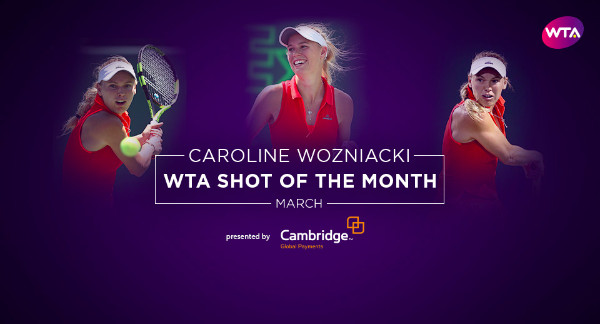
March was packed with plenty of amazing shots – we narrowed it down to the five best.
In the end, it was Caroline Wozniacki’s sneaky lob that took top honors. Taking on Lucie Safarova in the Miami Open quarterfinals, the former World No.1 relied on her full defensive arsenal against the big-hitting Czech veteran. As Safarova approached the net, the eventual finalist pulled off an impressive lob that left her opponent frozen at net.
Click here to watch all of March’s finalists.

Final Results for March’s WTA Shot Of The Month presented by Cambridge Global Payments
1. Caroline Wozniacki (36%)
2. Kirsten Flipkens (24%)
3. Venus Williams (22%)
4. Bethanie Mattek-Sands (10%)
5. Elena Vesnina (8%)
2017 WTA Shot of the Month Winners
January: Agnieszka Radwanska
February: Angelique Kerber
How it works:
Five shots are selected by wtatennis.com
Winner is then determined by a fan vote on wtatennis.com
An interview with Ana Ivanovic after her quarterfinal win at the St. Petersburg Ladies Trophy.