Montréal: Shot Of The Day (Wednesday)
Eugenie Bouchard had Wednesday’s shot of the day at the Rogers Cup.


Eugenie Bouchard had Wednesday’s shot of the day at the Rogers Cup.
WTA Insider | It’s a Manic Thursday in Montréal, with all eight round of 16 matches taking place at the Rogers Cup. Stay tuned for all the action in the latest Live Blog!
Angelique Kerber takes on Daria Kasatkina in the quarterfinals of the Rogers Cup.
NANCHANG, China – No.8 seed Han Xinyun avoided an early exit at the Jiangxi Open with a battling win over qualifier Junri Namigata on a sweltering opening day.
Watch live action from Nanchang this week on WTA Live powered by TennisTV!
Success has proved hard to find this summer for Han, who arrived in Nanchang with only one win in her past five tournaments. And it looked like more disappointment was on the cards when Namigata raced through the opening set.
However, Han had other ideas, pinching a tight second set to ensure a tense finale. She continued to sail close to the wind in the decider, coming within a couple of points of defeat before eventually prevailing, 2-6, 6-4, 7-5.
“I’ve been trying to get used to the weather,” Han said. “I didn’t feel in good form in the very beginning and was just trying to hang in there at the end. It wasn’t my best tennis today but I won and now I can look forward to the next round.”
There she will face compatriot Duan Ying-Ying, who eased past Marina Melnikova, 6-2, 6-2. Also advancing was Risa Ozaki, who wisely kept her time on court to a minimum, swatting aside lucky loser Han Na-Lae, 6-3, 6-1. The No.7 seed’s reward is a meeting with Nicha Lertpitaksinchai, after she defeated fellow Thai qualifier Peangtarn Plipuech, 6-2, 6-4.
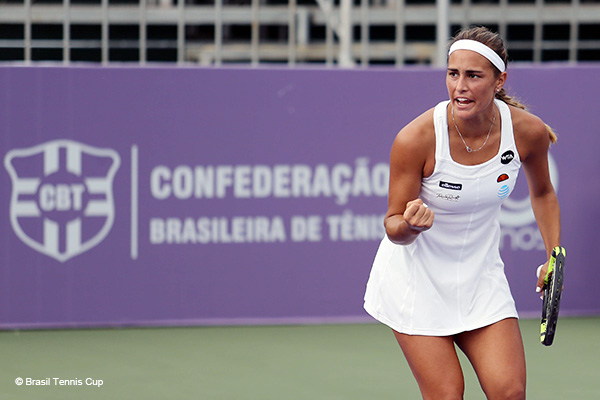
FLORIANOPOLIS, Brazil – Top seed Jelena Jankovic was sent crashing out of the Brasil Tennis Cup at the hands of Romania’s Ana Bogdan in straight sets, 6-2, 7-5.
Watch live action from Florianopolis this week on WTA Live powered by TennisTV!
Jankovic struggled as much with the conditions in southern Brazil as she did against her No.127 ranked opponent.
“It was a tough match overall. It’s completely different conditions here playing in the evening,” she said. “The ball moved so slow – it didn’t go anywhere. I hit as hard as I could, it wouldn’t take spin, nothing.
“The conditions didn’t really suit my game. It was better for Bogdan, and she won.”
Both players’ discomfort with the heavy conditions was evident in the 12 breaks of serve throughout the course of the hour and a half match. In fact, Bogdan was the only one to manage to hold in the opening set, doing so twice to put herself firmly ahead in the score.
Jankovic was able to impose her game more in the second set, and broke Bogdan’s serve three times to climb to a 5-4 lead and bring up three set points. The Romanian denied her the chance to even the scoreboard and broke right back.
“I just wanted to continue playing and not think about the score or anything else,” Bogdan said of the nerve-wracking moment. “Sometimes you get really nervous and you can’t control your emotions. I knew who she was and what a great champion she was, but I just tried not to think about that. I just kept going and believed in myself.”
Bodgan powered through to take the next two games and book a spot in her second WTA quarterfinal of her career.
“It’s definitely one of the greatest victories I’ve had until now,” Bodgan said. “I can’t compare it to any other match I’ve played.”
Bogdan will face Tereza Martincova in the next round. The Czech came away the winner in her match against lucky loser Lyudmyla Kichenok, the author of last round’s big upset of defending champion Teliana Pereira.

No.3 seed Monica Puig had a more straightforward road to the quarterfinals after defeating Olga Savchuk 6-0, 6-4.
After being completely shut out in the first set, Savchuk came out swinging in the second, playing more aggressively and hitting more winners. The change of tactic wasn’t enough to breakthrough against the Puerto Rican’s solid hitting, and Puig earned the decisive break in the ninth game to take the match after barely past an hour.
“It’s nice to be back here in Latin America where I have my roots,” Puig said after the match. “It feels very nice to be representing as the No.1 Latin American player. There’s always a lot of pride and responsibility on my shoulders, but I like it.”
Up next for Puig is the No.8 seed Naomi Osaka, a familiar face for her as the two have been practicing together earlier in the week.
“She definitely hits the ball very hard and has a big serve,” she said. “I’ll just focus on my game and do what I need to do put her in trouble, but I have a lot of respect for her of course.”
Also into the quarterfinals is No.4 seed Jelena Ostapenko who is set to take on No.6 seed Timea Babos. Ostapenko comfortably dispatched Argentina’s Catalina Pella 6-2, 6-3, while Babos came through after a commanding win over Alizé Lim, dropping just one game in the 6-0, 6-1 romp.
No.2 seed Irina-Camelia Begu dashed the last of the Brazilian hopes for a home champion as she defeated Paula Cristina Goncalves in straight sets. Goncalves was one of five Brazilians in the draw and the only one to advance past the first round, but she couldn’t move on against Begu, who downed her 6-1, 6-2. She’ll play No.7 seeded Nao Hibino next after the Japanese player edged Veronica Cepede Royg 6-3, 7-6(6).
A mixture of fresh and familiar faces assembled for third edition of the Jiangxi Open. Find out what the players have been up to on and off the court…
FLORIANOPOLIS, Brazil – Irina-Camelia Begu produced a stirring fightback to defeat Timea Babos and win the Brasil Tennis Cup on Friday.
After looking out of sorts in the first set, Begu dragged herself back into the contest to halt Babos’ charge in the second. A break in the ninth game saw her take the match the distance and despite falling 2-0 behind in the decider she rallied once more to win, 2-6, 6-4, 6-3.
“During the match I didn’t start really well – I was a little bit tense and focusing too much on the negative rather than the positive things I was doing. Then I realized I had to make the most of the situation, if the forehand wasn’t working I needed to use the backhand more,” Begu said. “I think it was more mental because I really wanted to win the title.”
The result secures Begu the third title of her career, reaffirming a love affair with the country which played such a crucial role in her comeback from a serious shoulder injury.
“This country is really special for me. In 2014, I was around 130, 140 [in the rankings], I don’t really remember, and I started with the small tournaments, then Florianopolis and Rio,” Begu said. “Being here for five weeks I got to see that the people are really nice, the food is great, too. I was also doing well, winning some of the tournaments, the $25Ks, so it was a nice comeback for me. If I have the chance I will come back again!”
Victory also provides the perfect send-off ahead of the Romanian’s trip up the coast to Rio where she will compete in her second Olympics, beginning her challenge against Nao Hibino. Babos, whose four-year wait to add to her solitary WTA title continues, meanwhile has a day to lick her wounds before a first-round meeting against Petra Kvitova.
“It was a difficult final emotionally, especially as I felt I had it in my hands, then only at the end I realize I’ve lost,” Babos said afterwards. “Of course I was playing against a very good player – she was fighting all the way – but I thought that I was playing better and I had many, many, many opportunities, so obviously I’m sad to lose this final.”
An interview with Eugenie Bouchard before her first round at the Olympic tennis event.
RIO DE JANEIRO, Brazil – Johanna Konta won a marathon encounter with Svetlana Kuznetsova on Tuesday afternoon to advance to the quarterfinals of the 2016 Olympics.
After just over three hours on court a weary Kuznetsova tugged the ball wide to hand Konta a thrilling 3-6, 7-5, 7-5 victory.
“That’s the longest match I’ve had for ages! I’ve been very fortunate to be part of some spectacular matches in my career and that definitely ranks up there because it’s my first Olympics,” Konta said.
Konta has been playing the tennis of her life this summer, but for the first hour against Kuznetsova it looked like this hectic schedule was finally catching up with her.
Trailing 2-0 in the second set, Konta’s punchy groundstrokes finally began to penetrate her opponent’s defenses, a run of four straight games hauling her back into the contest. Despite surrendering this advantage, the Briton hit back to level the match and then forge ahead in the decider.
Kuznetsova has enjoyed an enviable career, yet has failed to end either of her previous Olympic campaigns on the podium. And even when the cause appeared lost, her desire for this missing medal ensured a tense finale.
Serving for the match at 5-3, Konta came within two points of victory only to falter. This saw the momentum swing back towards the Russian and in Konta’s next service game she carved out three more break points.
Back came the World No.13, a sequence of fearless ball striking enabling her to edge ahead once more. With the finishing line within reach once more, Konta’s nerves reappeared, squandering three match points closing out a famous victory at the fourth time of asking.
Konta, who was ranked outside the Top 200 four years ago, is making her Olympic debut and has found it hard not to become swept up in the spirit of the Games: “Well once you get on court it’s about the opponent, it’s about yourself, it’s about competing. But I do think there are slight differences especially this year there are no ranking points. A lot of players play inspired when it comes to their country and that’s how it should be.”
In the last eight, Konta will face either No.2 seed Angelique Kerber after she brushed aside Samantha Stosur, 6-0, 7-5.
That's what it meant to Johanna Konta!#Rio2016 https://t.co/wd8dFDsc5h pic.twitter.com/TMyXjwdVlo
— BBC Sport (@BBCSport) 9 August 2016
RIO DE JANEIRO, Brazil – A pair of Olympic debutantes will try to knock off two experienced southpaws with the Gold medal match on the line. It’s semifinal time at the 2016 Olympic Games! Chris Oddo breaks down the match-ups for wtatennis.com.
Friday, Semifinals
Centre Court
[11] Petra Kvitova (CZE #14) vs. Monica Puig (PUR #34)
Head-to-head: First meeting
Key Stat: Puig is bidding to become the first Puerto Rican tennis player to win a medal at the Olympic Games.
Talk about making the most of an Olympic debut! Puerto Rico’s Monica Puig has dropped just 14 games en route to a semifinal appearance at Rio, and on the way the 22-year-old notched a career-best win in terms of ranking when she drubbed World No.4 Garbiñe Muguruza, 6-1, 6-1. Puig is riding an emotional high in Rio that she says is unlike any other. “It’s for my country, and I think nothing in the world can compare to that,” she told the Associated Press after defeating Germany’s Laura Siegemund in straight sets on Thursday. “It’s the most special feeling when you put on the colors of your country and you’re walking around the Olympic Village and everybody looks to see your country on the back of your shirt.” Puig will no doubt be inspired on Friday when she faces Petra Kvitova for a spot in the Gold medal round, but Kvitova is a woman who knows a thing or two about playing for national pride as well. The Czech has ably led her nation to four Fed Cup titles and she will look to add an Olympic medal to her fine international resumé when she faces Puig for the first time on Friday. Though it has been an up and down year for Kvitova, she has been in menacing form at Rio and looks primed to reassert herself as one of the dominant forces in tennis. Will Puig be able to ride the emotional wave past Kvitova, or will the legendary southpaw stay hot and break through to her first final of 2016?
Pick: Kvitova in three
[2] Angelique Kerber (GER #2) vs. [7] Madison Keys (USA #9)
Head-to-head: Kerber leads, 4-1
Key Stat: Keys has lost all three of her previous matches against Kerber on a hardcourt.
With Serena Williams out of the draw in Rio, No.2 seed Angelique Kerber has stepped in with confidence to book her spot in the last four, but she’ll have to pass her most difficult test of the Olympic Games if she is to reach the Gold medal match. Standing in Kerber’s way on Friday will be the daunting American Madison Keys, a player that has done nothing but impress since late spring. The 21-year-old has gone 25-4 since early May, playing finals in Rome and Montréal while winning the title in Birmingham. On Thursday she blitzed Russia’s Daria Kasatkina, finishing with 30 winners to just four for Kasatkina. Will Keys be able to achieve the same level of dominance against the fleet-footed, feisty Kerber? Unlikely, but Keys’ current form says that she is in this battle with a good chance to win. Though she has lost two in a row to the World No.2 she does own a win over Kerber and took the German to three sets in a wildly entertaining Charleston final in 2015. This semifinal promises to be a thrilling encounter of stylistic opposites. Kerber, the gritty, indefatigable counterpuncher, versus Keys, the scout’s dream with power to burn and a penchant for attacking. Who will emerge victorious?
Pick: Kerber in three
Around the grounds…
Women’s doubles will also be taking center stage on Friday in Rio as both semifinals are slated for Court No.2. The No.5 seeds, Martina Hingis and Timea Bacsinszky of Switzerland, will face the No.6 Lucie Hradecka and Andrea Hlavackova of the Czech Republic, while unseeded Lucie Safarova and Barbora Strycova square off with the seventh-seeded Russian pairing of Ekaterina Makarova and Elena Vesnina.