Birmingham: Story Of The Tournament
The story of the tournament at the Aegon Classic.
CHARLESTON, SC, USA – Few can claim to be a more voracious reader than Andrea Petkovic, and the German sat down with Joel Drucker of Tennis Channel at the Volvo Car Open this week to put her skills to the ultimate test.
Petkovic, who is as much a Renaissance woman as she is a professional athlete, has a well-rounded range of interests that span from art and music to literature, which she called her escape in the sit-down with Drucker following her first round victory in Charleston.
“Some people escape with drugs and alcohol. For me, it’s literature,” the 29-year-old said.
The 2014 Volvo Car Open champion often gives followers and fans a glimpse into her eclectic world off the court on social media, whether it be by documenting visits to museums in her world travels, quoting Robert Frost on her Twitter account — or taking a book into the ice bath at the US Open.

Four of the German’s favorites authors — Ernest Hemingway, Saul Bellow, Friedrich Nietzsche and Leo Tolstoy — span generations and have few peers in the realm of literature, but just who would they be like if they picked up a racquet?
On Hemingway…
“He plays short points – really likes to go to net. Definitely would chip-charge. He’s tall, handsome – much like Patrick Rafter.”
On Bellow…
“He hits big, powerful shots – like Alexander Zverev. He’s a spectacular, hard-hitting player who loves the big sentence and brings lots of philosophical insight.”
On Nietzsche…
“He’s like Ivan Lendl. He’ll grind it out. He likes to suffer.”
On Tolstoy…
“A percentage player. He always plays the right shot – a baseliner, sort of like Caroline Wozniacki. Just a terrific all-around player.”
Stay tuned for part two from Tennis Channel, coming soon as the former World No.9 compares some of tennis’ greats, along with her peers and compatriots, to some of history’s best authors.
An interview with Belinda Bencic before her opening round match at the Aegon International.
Caroline Garcia has Wednesday’s shot of the day at the Abierto GNP Seguros.
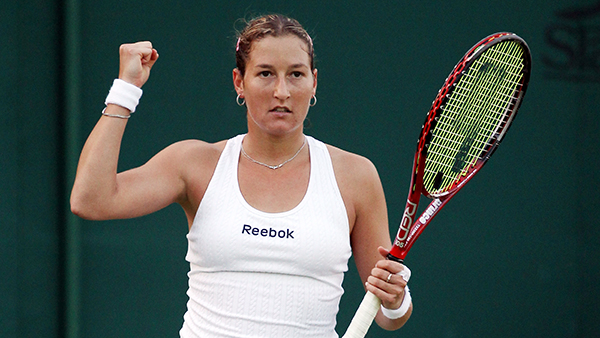
Timea Bacsinszky hasn’t always loved the grass. Before she returned to the tour after a three-year break, she was 3-5 in her career on the turf. “I was kind of afraid of grass for many years, but since I came back in 2013 [it’s changed].” Indeed, since her return three years ago she is 10-4 on grass with a Wimbledon quarterfinal already under her belt last year.
Bacsinszky’s first match on grass in three years came at Wimbledon qualifying in 2013. It was just the second tournament she played since deciding to return to the tour (the first being Roland Garros). “I played against Madison Brengle and I ended up winning 6-4 in the third.” Bacsinszky said during All-Access Hour at the Aegon International on Monday. “For me it was like a miracle, like coming from nowhere playing in Roehampton, which is like a potato field,” she said, much to the delight of a laughing press corp.
“All my respects to Roehampton, they are trying their best, but it’s not really the most glamorous grass court ever. With those like funny conditions, you have many courts everywhere and it’s like a bazaar. It’s like a zoo over there. I ended up winning a match. I was like, wow. And almost won my second match but I lost against Schmiedlova 7-5 in the third.”
Slowly, the always adaptable Bacsinszky, who has posted her best results on clay and hard courts, began to realize her game could flourish on grass.
“My game is quite good right now on grass because I’m able to play longer rallies if I really need to,” she said. “I know it’s not good to defend on grass, but I can be in that position to give one extra ball back for my opponent and to mix up with the spins to be able to come to the net, to be able to maybe do a chip and charge. I’m not even at 1% of Roger’s level in that, but I’m trying to improve my game and to make, yeah, everything possible what I can that can help me to play well on grass.”

Roger Federer is a seven-time Wimbledon champion. Belinda Bencic is a junior Wimbledon champion and won the Aegon International for her first title last year. Stan Wawrinka is a two-time Wimbledon quarterfinalist and Bacsinszky has also made the Wimbledon quarterfinals. Martina Hingis is a Wimbledon champion in singles and won the doubles title with Sania Mirza last year.
So what gives? Why are the Swiss so solid on grass? As is her wont, Bacsinszky had an interesting take.
“I think it’s not something about the surfaces but it’s more that being in the middle of Europe tennis-type-wise you have all those influences,” she explained. “The French are playing like they like the nice game, coming forward, making big shots, aesthetically nice, a lot of culture of tennis.
“Then you have the Spaniards fighting for every point, they don’t give a s***. And they just like go for every ball, try to give back so many balls, try to make work the [opponent]. Okay, you’re gonna say not every Spaniard, for sure. There are always the exceptions; Muguruza is not that type of player.
“The majority of Spaniards are like, ‘Okay, I’m going to fight for everything, and the spirit of clay court. Even if I have to chip everything, I’m going to win the match even if it’s ugly. Even if it’s playing with the other side of the racquet, I don’t care.’

“Italy can be also like this. It’s a mixture. And then you have Eastern Europe, which are based on the baseline hitting everything, going for the lines, trying to take the ball early, putting a lot of pressure.
“Why Switzerland, why we have so many maybe good players? We have all these influences. And I think that’s what it’s like in the Swiss mentality, you’re open for everything. We have to learn more languages, every kid has an education. Most of the people have a job, a decent job. They work hard. We like to work. It’s all the system which works.
“And maybe – it’s a small parallel to say that – maybe that’s why we can also play well on grass, because we are open minded. We say, ‘Okay, we are gonna fight for every point. We are gonna try to hit balls. We’re gonna try maybe new things and we are going to accept the situation and how it is.’ And so we go for it.”
But for Bacsinszky it’s more than just about being Swiss. A child of Hungarian immigrants, she traces part of her her autonomous drive – her Twitter hashtag motto is #limitless – to her parents.
“My mom and my dad were, when I was a kid, telling me you have to fight for what you have, you have to fight for who you want to be, it’s not only given. You have to go and work for what you really want to get. It’s probably why also I’m restless. If I commit to something, I really want to go to my maximum. I never know where my limits are, where my maximum is, but I’m trying to seek it.

“It’s probably because of the Hungarian influence, because they have been beaten so many times in war. They were such a big empire. But we are also quiet population. In Switzerland, you don’t say, ‘Oh, I’m a proud Hungarian.’ Other countries, they would all the time have the flags and stuff. But Hungarians are I believe in foreign countries they are really super quiet.
“I have this will and probably it’s coming from that. You have to fight. Like my dad fought to get away from Romania. He was Hungarian but in the Hungarian minority of Romania, and he couldn’t pass the borders and had to arrange a marriage in order to get out. I mean, political refugee.
“It was really tough. My mom had an easier situation, but I know it wasn’t easy for them. And I grew up with that. So that’s why I fought all the time for everything, what I did. It’s probably because of that.”
Click here to read more about this year’s Wimbledon Contenders, courtesy of WTA Insider.
All photos courtesy of Getty Images.
MONTERREY, Mexico – Top seed and World No.1 Angelique Kerber reached her fourth quarterfinal of 2017 on Thursday, closing out the night session and a big-hitting Mandy Minella, 6-1, 6-3 at the Abierto GNP Seguros.
“It was a good match from me,” she said after the match. “I played very well, and was able to play aggressively from the first point. I enjoyed the match tonight.”
Crafty lob from @AngeliqueKerber! ? pic.twitter.com/vCBZcBAeTc
— WTA (@WTA) April 7, 2017
Minella has enjoyed a stellar start to the season, reaching the semifinals at the Taiwan Open and earning an impressive win over Kristyna Pliskova at the Miami Open, but came up against a firing Kerber in Monterrey.
The German dropped just three points behind her first serve and didn’t face a break point all match, converting four of the eight she earned on the reigning Bol Open winner.

Kerber has slowly recovered from a tough first quarter, reaching the semifinals at the Dubai Duty Free Tennis Championships and the quarterfinals in Miami, and is still looking for her first title of the year.
Up next for World No.1 is defending champion Heather Watson, who enjoyed a strong win over Ekaterina Makarova, 6-4, 6-1, earlier in the day.
Just too good from @AngeliqueKerber ? ? pic.twitter.com/My4Mjv1H4O
— WTA (@WTA) April 7, 2017
“I think it’ll be a good match; she won here last year and is the defending champion, so she knows the court and venue.
“I think I’ll have to play like today, play my game. I’m looking forward to playing against her.”
.@AngeliqueKerber races past Minella 6-1, 6-3!
Sets @Abierto_GNP Quarterfinal vs defending champ @HeatherWatson92! pic.twitter.com/hOrRPIwXRj
— WTA (@WTA) April 7, 2017
All photos courtesy of Abierto GNP Seguros.
ROEHAMPTON, Great Britain – The first round of Wimbledon qualifying began on Tuesday afternoon, and six of the Top 8 seeds have already won their opening matches. Top seed Tatjana Maria led the way with a 6-1, 6-3 victory over Myrtille Georges, setting up a second round encounter with former Australian Open junior champion An-Sophie Mestach, who needed three sets to get past young American, Sachia Vickery.
Maria earned her best career Grand Slam finish at last year’s Wimbledon championships, reaching the third round before falling to eventual quarterfinalist Madison Keys.
No.2 seed Viktorija Golubic was made to work harder in her first round against former Top 100 player Anastasia Pivovarova, who was playing in her first Grand Slam event since 2012. Edging out the opening set in a tie-break, the Swiss Fed Cup heroine had to fight through the next two before ultimately engineering a second round meeting with countrywoman Amra Sadikovic, who eased past Oceane Dodin, 6-4, 7-5. Sadikovic briefly retired from tennis before enjoying a rollicking comeback, one that has already seen her reach the quarterfinals of Bogota and return to the Top 150.
Lucie Hradecka was looking to cause the upset of the day against No.3 seed Zhang Kai-Lin; though the former Top 50 veteran served for each set, she ultimately fell, 7-5, 7-5. Zhang booked a second round encounter with Tereza Smitkova, who reached the fourth round of the All England Club in 2014.
No.4, No.5 and No.7 seeds Aleksandra Krunic, Maria Sakkari, and Tamira Paszek dropped a combined five games in their first rounds. Sakkari blew past young Russian Polina Leykina, 6-0, 6-0, in 45 minutes, while two-time Wimbledon quarterfinalist Paszek defeated Amandine Hesse, 6-2, 6-1.
Second round action begins on Wednesday.
CHARLESTON, SC, USA – If Caroline Wozniacki scores just one more victory at the Volvo Car Open and defeats World No.66 Jelena Ostapenko, she’ll be rewarded with more than just a spot in the Charleston semifinals: she’ll be projected to break back into the Top 10 when the new WTA rankings come out, a happy ending to what has been an absolute rollercoaster last few years.
Wozniacki got her first taste of the Top 10 back in 2009, and has been a mainstay at the top of the rankings for the majority of her career – including a stint at World No.1, a ranking she held for 67 weeks.
In fact, from 2009 to 2014 she finished each year inside the Top 10, and her six year run had been the WTA’s longest active streak.
But a struggle with injuries and recovery derailed the Dane’s progress, causing her ranking to plummet to as low as No.74 during the 2016 US Open.
It was during that US Open fortnight that Wozniacki’s comeback came together; she entered the tournament unseeded and went on to reach the semifinals, knocking out the likes of Svetlana Kuznetsova and Madison Keys along the way.
Once she got going, Wozniacki never looked back, and in the 14 events since her ranking dipped to No.74, she’s put together a stunning run which includes titles at the 2016 Toray Pan Pacific Open and the Prudential Hong Kong Tennis Open, runner-up finishes at the 2017 Qatar Total Open, Dubai Duty Free Tennis Championships and Miami Open, and a semifinal finish at the US Open.
She’s reached the quarterfinals or better at 11 of her last 14 events and now, by virtue of her incredible consistency, Wozniacki sits one win away from a return to her beloved Top 10 – the first time she’ll be there since September 21, 2015.
It won’t be easy with Latvian teenager Ostapenko standing in her way; Wozniacki lost in straight sets the only previous match they’ve played at last year’s Connecticut Open. And due to extreme weather conditions in Charleston, Wozniacki found herself having to double up and play two matches on the same day to reach the quarterfinals.
“I think I’m well-prepared for tomorrow,” Wozniacki said after her win against Anastasia Rodionova. “I got some clay tennis in today and feel like I’m just going to go out there and have fun and do my best and see how it goes.
“I’m just playing right now. I had one practice session before the tournament started for me, and that was it. I just kind of run on experience and try and figure it out.”
Petra Kvitova and Wimbledon go together like strawberries and cream. Since 2010, Kvitova has made the quarterfinals or better five times, winning the title twice in 2011 and 2014. The All England Club is where Kvitova has made her mark, emblazoned her name, and played her absolute best. And it’s where she’s been able to kickstart a season when she’s arrived on a sputter.
Kvitova has yet to get her game going in 2016. She made the quarterfinals or better at just two events this year and has slipped out of the Top 10 for the first time since 2013. She will be seeded outside the Top 8 for the first time since 2010. Despite it all, Wimbledon has a firm history of curing all that ails her. Kvitova just needs to get on a roll.
“I remember in 2011, I was injured in my leg, which wasn’t really nice,” Kvitova told WTA Insider. “I was coming from Eastbourne and I remember I was supposed to play on Monday but it was raining so I was so happy to play on Tuesday. I played the final in Eastbourne and I felt like the tournament just continued. It’s not like a new tournament, new Grand Slam, so I was just flowing.
“Nobody really expected – me neither – that I can play so well there. For me it was a really special moment and really a surprise. I didn’t know how to handle it.

“It was totally different [in 2014]. I think in the second Wimbledon I think there was kind of expectations already. It was much more difficult. I played three Czech girls on the journey. I didn’t really feel like I could win it again but I was just so focused. After the final I was just feeling so much deeper, so satisfied with everything. It was something more than the first one.”
Kvitova will be playing Wimbledon without her long-time coach David Kotyza. The two split after the Australian Open and she’s now coached by former ATP player Frantisek Cermak. Their best results of the season came in the quarterfinals of the BNP Paribas Open and semifinals of the Porsche Tennis Grand Prix.
“I think that I’m kind of feeling that I am playing well, even though I kind of lost some of the matches in a couple of months,” Kvitova said at the Aegon International. “But I think it’s pretty good. The main thing is to stay healthy, for sure. Otherwise I feel good.”

Kvitova said the biggest struggle for her as been keeping focus in matches. “I do work with my mental coach,” she said. “I think it’s getting better, as well. But you never really know. Kind of these [tight] matches, it’s difficult, always under the pressure and the players are playing without any expectation or anything. Sometimes it’s difficult to stay still, very focused on every kind of point.”
In 2014, Kvitova arrived to Wimbledon without a title under her belt for the season. Her draw got her two fairly easy opening opponents before she locked in to beat Venus Williams, 5-7, 7-6(2), 7-5 in one of the best matches of that year. Kvitova then capped it off with a 6-3, 6-0 win over Eugenie Bouchard in just 55 minutes.
As Kvitova says herself, she doesn’t need much practice to matches to play well. They clearly help her confidence, but deep down Kvitova knows her game is there. She just needs to find it in time.
“I just know that it’s there,” Kvitova said. “[The way] you were training before you can’t really forget.”
Listen to more of Kvitova’s thoughts on the upcoming Championships in the latest episode of the WTA Insider Podcast:
Click here to read more about this year’s Wimbledon Contenders, courtesy of WTA Insider.
All photos courtesy of Getty Images.
CHARLESTON, SC, USA – 19-year-old Jelena Ostapenko stunned No.11 seed Mirjana Lucic-Baroni in three sets to reach the final at the Volvo Car Open, 6-3, 5-7, 6-4.
With the victory Ostapenko is through to her third career final – and her first on clay – where he’ll face fellow-19-year-old Daria Kasatkina.
“It’s really nice to be in the third final, but first final on clay court, and especially here in Charleston,” Ostapenko told press after the match. “I’m really looking forward for tomorrow’s match.
“[Daria] kind of defensive player, and I think clay is her favorite surface, but I’m just going to try to stay consistent and be aggressive at the same time and just play my game.”
We're going three!
Mirjana Lucic-Baroni battles back to force a decider over Ostapenko 3-6, 7-5! #VolvoCarOpen pic.twitter.com/2g3oMKIpc5
— WTA (@WTA) 8 de abril de 2017
Just one point made the difference between Ostapenko and Lucic-Baroni during the tense, two-hour-and-seven-minute encounter. The Latvian employed her aggressive, fearless tennis against Lucic-Baroni, changing the direction in the ball and keeping her opponent on the run with her heavy groundstrokes.
Ostapenko was serving for the match at 5-4 in the second, but Lucic-Baroni had other ideas and the Croat put together a mammoth struggle to deny Ostapenko and break her serve.
Jelena Ostapenko edges Lucic-Baroni 6-3, 5-7, 6-4!
Sets All-Teen @VolvoCarOpen Final vs @DKasatkina! #VolvoCarOpen pic.twitter.com/ugpZVK2IAh
— WTA (@WTA) 8 de abril de 2017
She unleashed a barrage of winners against the Latvian, who had no response as Lucic-Baroni grabbed the next two games to take the match into a decider. But Ostapenko tamped down her nerves in the third and found her calm to make her way into her first final of 2017.
“I actually was quite emotional in the second set when I was 5-3 up and I couldn’t finish the set, but she liked when I was emotional,” Ostapenko admitted. “It kind of gave her confidence till then.
“In the third set I was just trying to be calm because I think it was tougher for her because I didn’t show any emotions, and it helped me, so I won the third set.”